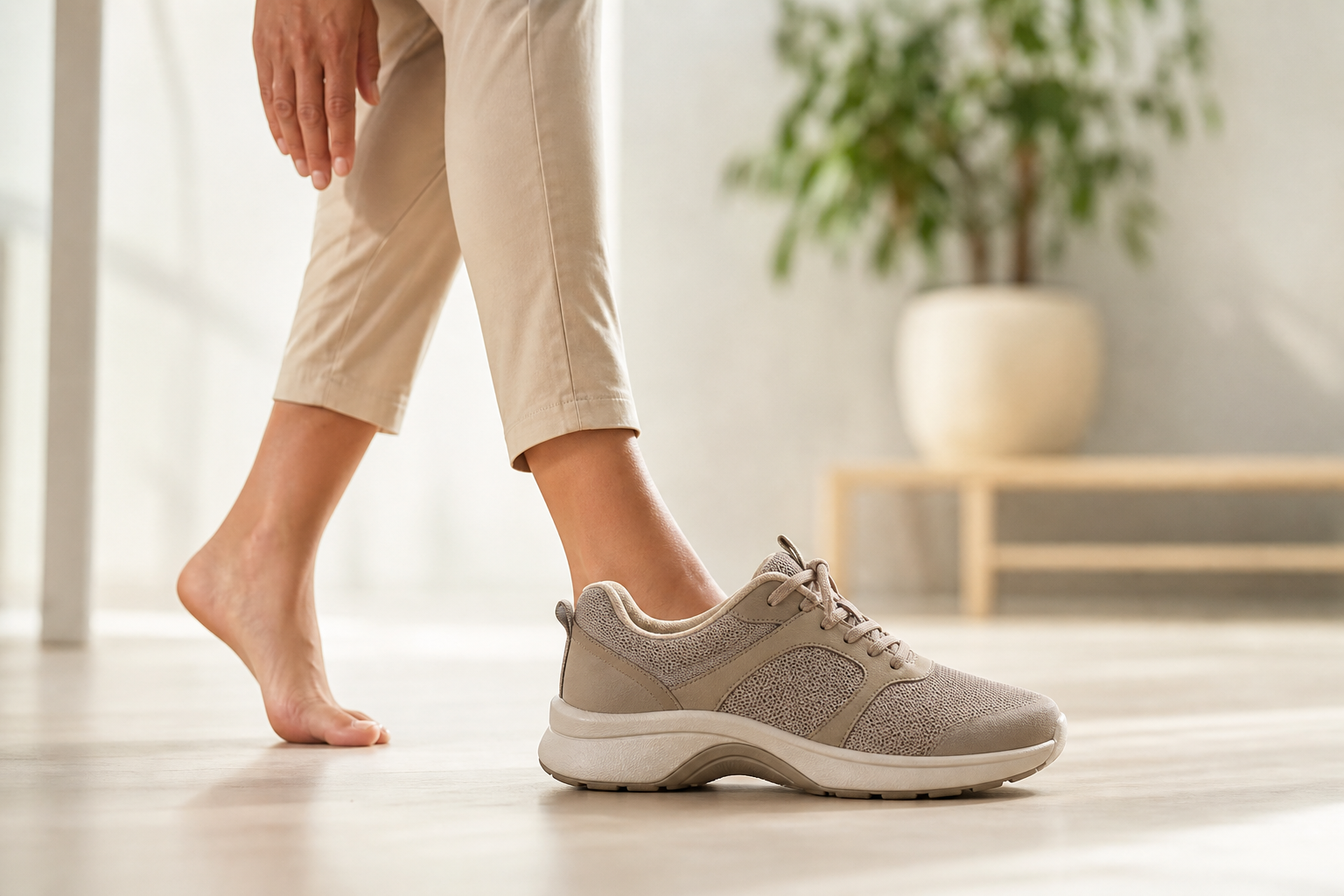
Why shoes can influence back pain
When someone spends a lot of time standing or walking, footwear can affect how body weight is distributed and how posture feels throughout the day. MedlinePlus notes that posture matters and that comfortable, low-heeled shoes can help avoid disrupting that alignment [1].
That does not mean a pair of shoes will solve low back pain on its own. It does mean the right footwear can make daily walking, standing, and longer errands feel less uncomfortable. For that reason, when people search for shoes for back pain, the key is to think about support, stability, and fit rather than style alone.
Shoe features that often help most
If you are looking for comfortable shoes for walking or footwear for back pain, a few features are commonly helpful:
- Good arch support: can help the foot feel more stable while walking.
- Balanced cushioning: may improve comfort without making the shoe feel overly soft or unstable.
- A steady, secure base: a sole with good traction can add confidence with each step.
- A comfortable fit: the shoe should not pinch the heel, instep, or forefoot.
The NIH also suggests checking fit carefully before buying: leave space for the toes, make sure the shoes feel comfortable right away, and try them later in the day when feet are often a bit larger [2].
What to avoid if you have low back or back pain
Not every shoe works the same way. If you have low back pain or general back discomfort, it is often sensible to avoid:
- Very flat soles with little support.
- Extremely stiff or unstable models.
- High heels or a pronounced slope.
- Poor foot hold or the wrong size.
MedlinePlus highlights that low-heeled shoes help avoid changing posture in an unhelpful way [1]. In practical terms, that often means less unnecessary strain when walking or standing. The goal is not to find a perfect shoe, but to reduce features that make the body work harder.
How to choose everyday shoes and walking shoes
Choosing appropriate shoes for back pain depends on how you will actually use them. A shoe for short trips is not the same as one for long walks or long days on your feet.
Before you buy
- Try both shoes, since feet are not always exactly the same size.
- Walk around for a few minutes and notice whether the shoe moves too much.
- Check that the toes have enough room.
- Make sure the heel feels secure.
If you plan to walk in them
The best shoes for walking are not always the softest. Often, the sweet spot is a mix of comfort, support, and stability. A shoe that feels very cushioned at first may still be less helpful if it becomes too unstable.
A systematic review in PubMed found that people with low back pain can walk differently [3]. That context helps explain why stability matters so much in footwear when back comfort is a priority.
Shoes for feet and back based on daily needs
Not everyone needs the same thing. Some people want an easy everyday shoe; others need a pair that can handle long walks or hours of standing.
If you spend many hours moving around, prioritize:
- overall foot support,
- good stability,
- a secure fit,
- a sole that does not slip easily,
- comfort from the first few steps.
If you are choosing between flexibility and support, notice which option lets you walk more naturally without feeling like your foot is sinking or sliding inside the shoe. When comparing shoes with good support, shoes with cushioning, or shoes with arch support, the real fit still matters most.
Common shoe-buying mistakes
Many problems come from small decisions:
- choosing a shoe only for looks,
- buying a size that is too tight,
- ignoring toe room,
- assuming softer always means better,
- wearing high heels for long activities,
- skipping the in-store walking test.
The NIH educational piece emphasizes checking comfort early and paying close attention to fit [2]. That advice is especially useful when you are trying to figure out what to avoid in shoes if back discomfort is part of the picture.
When to consult a health professional
If back pain continues, gets worse, or limits daily activities, it is wise to talk with a health professional. The same is true if changing shoes does not improve comfort or if walking becomes increasingly difficult.
Footwear can be a practical aid, but it does not replace an evaluation when discomfort does not ease. As MedlinePlus reminds readers, posture and movement habits are part of the broader picture [1], and staying active is often more helpful than relying on one single fix [4].
Bottom line
If you are wondering what shoes to wear for back pain, aim for a simple balance: support, stability, reasonable cushioning, and a good fit. Avoid shoes that change posture too much or hold the foot poorly. And if discomfort continues, professional guidance can help you look at the bigger picture.
Sources consulted
- [1] Guide to Good Posture — MedlinePlus — https://medlineplus.gov/guidetogoodposture.html
- [2] Focus on Your Feet! Take Steps to Protect Foot Health — NIH News in Health — https://newsinhealth.nih.gov/2023/03/focus-your-feet
- [3] Do people with low back pain walk differently? A systematic review and meta-analysis — PubMed — https://pubmed.ncbi.nlm.nih.gov/35151908/
- [4] How to manage low back pain before it gets worse — NIH MedlinePlus Magazine — https://magazine.medlineplus.gov/article/how-to-manage-low-back-pain-before-it-gets-worse