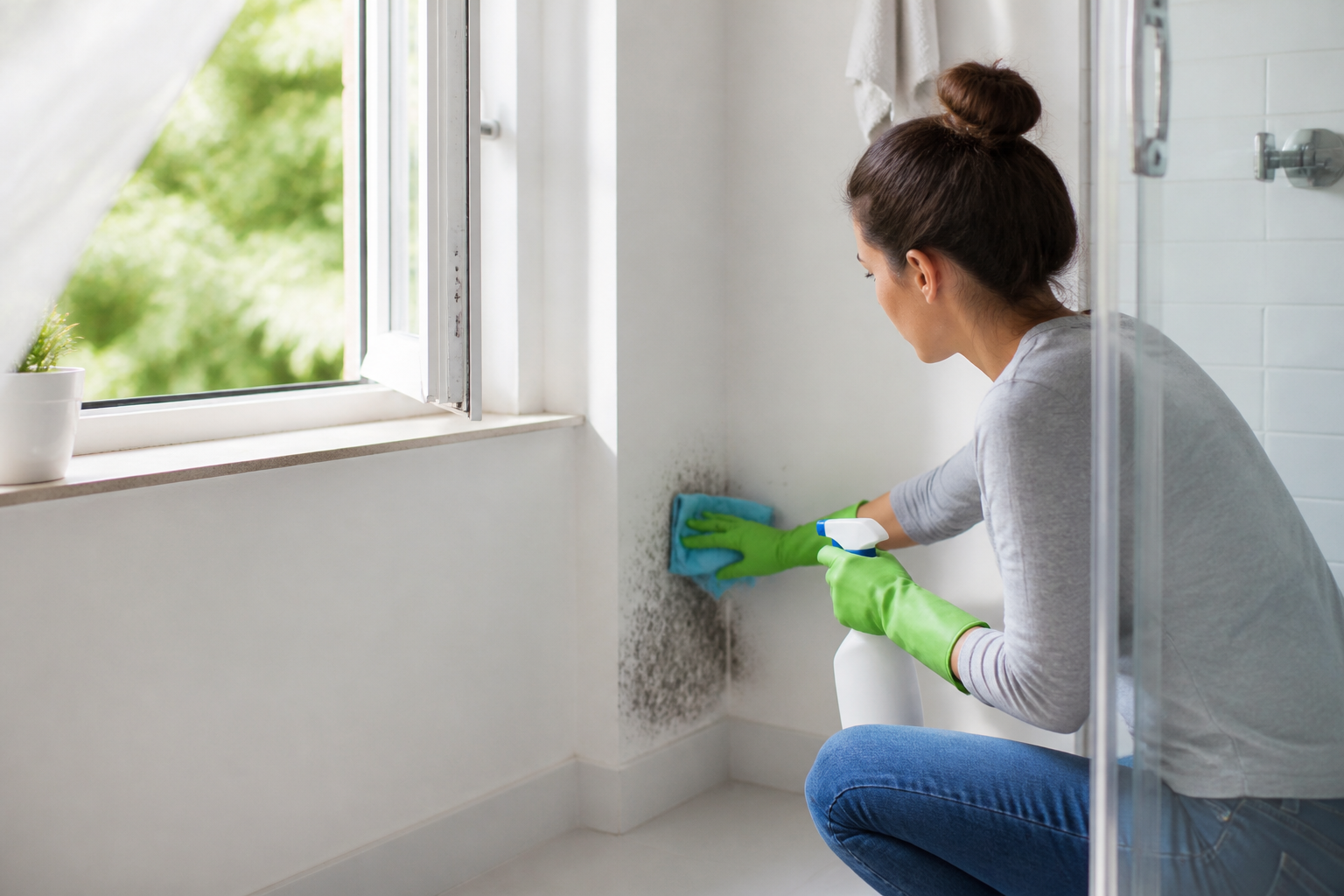
How to Clean Mold at Home Safely
Mold often appears when there is moisture, poor ventilation, or a leak. It does not always mean a major problem, but it is worth dealing with quickly so it does not spread. The CDC explains that mold grows indoors when moisture is present and that cleaning without fixing the moisture source can allow it to return [1].
What mold is and why it shows up
Mold is a fungus that can grow on damp indoor surfaces. It tends to appear where condensation, leaks, steam, or poor airflow are common. That is why it is so often found in bathrooms, on ceilings near leaks, and on some walls.
It helps to tell the difference between:
- a small, surface-level spot
- a larger or persistent area
- a problem that comes back after cleaning
That distinction helps you decide whether home cleaning is enough or whether a more complete evaluation is needed [1][4].
When you can clean it yourself and when to get help
In general, a small, isolated area can often be cleaned at home if the surface is reachable and the issue appears superficial. If mold covers a larger area, keeps returning, or seems to come from a structural leak, it is better to seek professional help [4].
It is also smart to get the area checked if there is a persistent musty smell, stains that return quickly, or materials that stay damp and do not dry properly.
How to clean mold safely before you start
Before you clean mold at home, gather the basics and ventilate the area well. The CDC recommends protecting yourself from direct contact, keeping fresh air moving, and not mixing incompatible cleaners [2].
Helpful prep steps:
- open windows or improve ventilation if possible
- use gloves and eye protection if needed
- move nearby items that could get wet
- avoid mixing cleaning products
The goal is not speed. The goal is careful, steady cleaning.
Step by step for nonporous surfaces
On hard, nonporous surfaces, cleaning is usually more straightforward. The general approach recommended by the institutional sources is to remove visible dirt, clean with soap and water or detergent, and dry the surface completely afterward [2][3].
Basic steps
- Remove dust or surface dirt first.
- Apply the appropriate cleaning method for the material.
- Scrub gently rather than aggressively.
- Rinse if needed.
- Dry the surface thoroughly.
Drying is essential. If moisture remains, mold can return even when the stain looks gone [1][3].
How to remove mold from walls without damaging them
To remove mold from walls, first identify the wall material. A painted wall is not the same as drywall or another delicate finish. The EPA notes that some porous materials can be damaged easily or may need replacement if mold has penetrated them [3].
If the stain is only on the surface, gentle cleaning may be enough. If the wall is soft, swollen, or holding moisture inside, the problem may be deeper. In that case, scrubbing harder will not help and may make the surface worse.
How to remove mold in the bathroom
The bathroom is one of the most common places for mold because of steam and condensation. The EPA points out that poor ventilation can allow mold to return in damp spaces like this [3].
Areas to check often:
- grout and corners
- tiles
- around sinks and showers
- places where condensation collects
After cleaning, reduce steam and let the space dry fully. Cleaning these areas more often can help stop buildup before it becomes a larger problem.
How to remove mold from ceilings and high areas
If mold appears on a ceiling, it is important to check whether it comes from a leak or condensation. Cleaning the visible stain without checking the source can leave the problem in place [1][3].
Be careful if the area is high up, and make sure the ceiling is completely dry before you consider the job finished. If the stain comes back, there may still be an active moisture issue.
Mold remedies: what helps and what to avoid
The most useful home remedies for mold are the simplest ones: careful cleaning, good ventilation, and complete drying. The institutional guides reviewed do not support improvised mixtures and specifically warn against combining incompatible cleaners [2].
What to avoid:
- scrubbing so hard that you damage the surface
- leaving behind residual moisture
- mixing cleaning products
- covering the problem without fixing the cause
How to keep mold from coming back
The best way to prevent mold at home is to control moisture. That includes ventilating kitchens and bathrooms, drying spills or condensation quickly, and repairing leaks as soon as possible [1][3].
It also helps to check common trouble spots regularly, especially if mold has appeared before. When the problem returns, cleaning again is not always enough; the moisture source needs attention.
Final checklist
Before you finish, confirm the following:
- the area is dry
- ventilation is adequate
- there is no lingering musty smell
- the stain does not reappear quickly
- the material does not show internal damage
If mold returns fast or covers a large area, it is worth consulting a professional to look at the underlying cause [4].
Sources consulted
- [1] CDC, Mold — https://www.cdc.gov/mold-health/about/
- [2] CDC, 8 Tips to Clean Mold — https://www.cdc.gov/mold-health/communication-resources/8-tips-to-clean-mold.html
- [3] U.S. Environmental Protection Agency, A Brief Guide to Mold, Moisture and Your Home — https://www.epa.gov/mold/brief-guide-mold-moisture-and-your-home
- [4] New York City Department of Health and Mental Hygiene, Guidelines on Assessment and Remediation of Fungi in Indoor Environments — https://www.nyc.gov/assets/doh/downloads/pdf/epi/epi-mold-guidelines.pdf