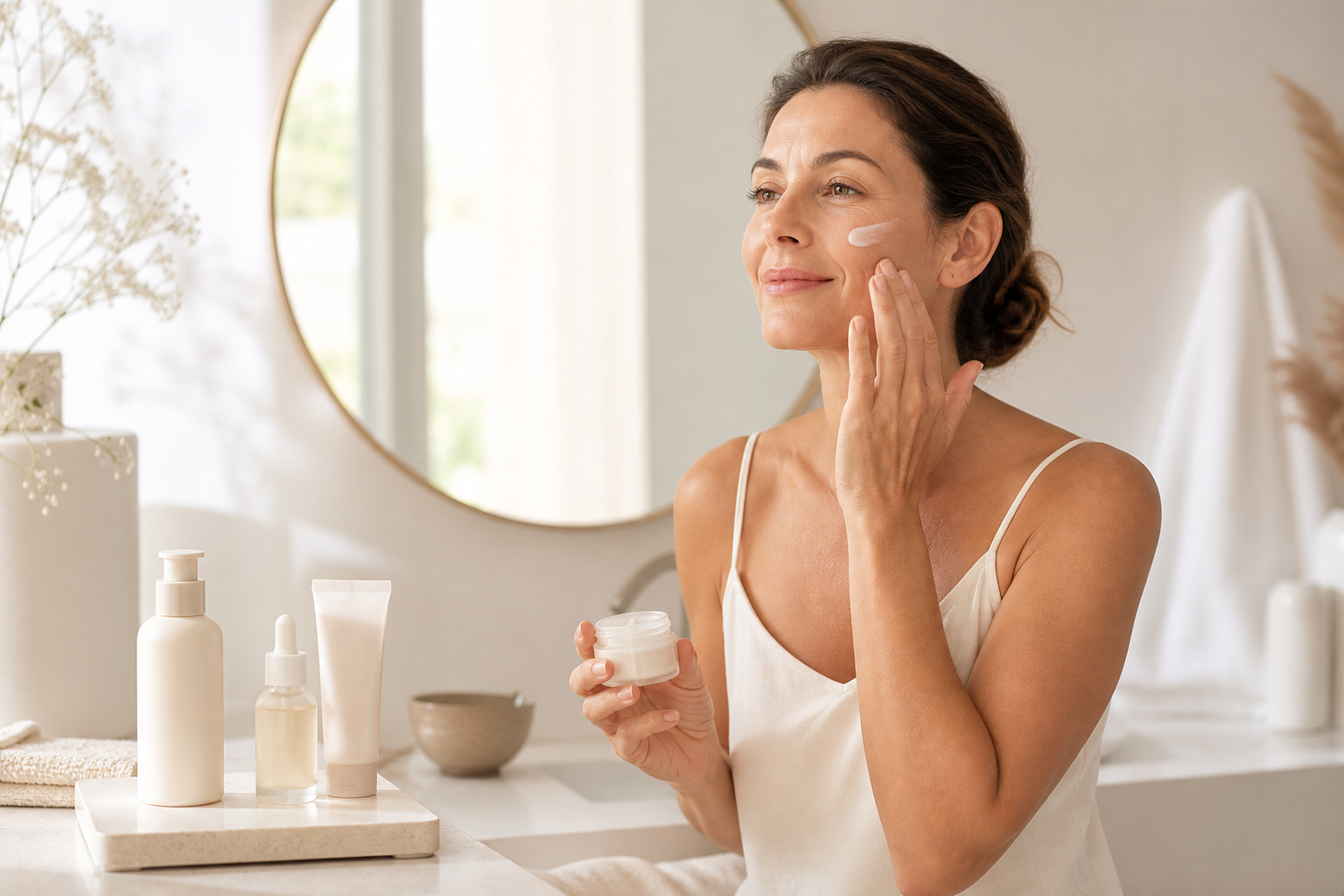
What changes in skin with age
A skin care routine by age does not need a complete reset over time, but it may need thoughtful adjustments. As the years pass, it is common to notice more dryness, changes in texture, gradual loss of firmness, and more visible fine lines. Cumulative sun exposure also matters, as does each person’s skin type [1].
That is why skin care by age is less about rigid rules and more about understanding what your skin needs at each stage. Sometimes the smartest change is not adding more steps, but making the routine gentler, more consistent, and more realistic.
The foundation that works at any age
Three pillars support a good routine at almost every stage of life: gentle cleansing, hydration, and sun protection. The American Academy of Dermatology also notes that it helps to avoid using too many products and to keep routines simple when the goal is a realistic anti-aging approach [3][4].
It also helps to separate a morning routine for the face from a night skin care routine:
- In the morning, the focus is on cleansing without stripping, hydrating, and protecting.
- At night, the priority is removing the day’s impurities and leaving skin comfortable before rest.
Consistency matters more than a long list of steps. A simple routine you can maintain is usually better than an elaborate one that is hard to follow.
Skin care in your 30s: prevention and balance
In your 30s, many people start thinking about how to change a skincare routine without making it complicated. At this stage, it often makes sense to reinforce facial hydration, support the skin barrier, and pay attention to early signs of dehydration or dullness.
The goal is not to fix everything, but to keep skin balanced. If your skin looks less fresh or feels tight, it may be a good time to check whether cleansing is too harsh or hydration is not enough.
This is also when some people become interested in an anti-aging serum or antioxidant ingredients. But the idea is not to add more for the sake of it. The useful question is: does this answer a real skin need, or is it only making the routine more complicated?
Skin care in your 40s: support, firmness, and hydration
In your 40s, many skin types benefit from a routine that focuses more on comfort, support, and hydration. The AAD recommends gentle cleansing, daily hydration, and facial sunscreen as key habits in this stage [2].
If fine lines become more noticeable or skin feels drier, it can make sense to adjust product textures or how often certain steps are used. Not every skin type tolerates the same approach, and adapting your routine also means respecting that tolerance.
At this stage, people often mention ingredients such as facial hyaluronic acid or retinol for skin, but always in a general sense and based on individual response. Rather than looking for a single answer, it helps to observe how your skin reacts and choose routines you can maintain without irritation.
Skin care in your 50s: comfort and mature skin
In your 50s, talking about skincare for mature skin does not mean chasing exaggerated promises. It means prioritizing comfort, softness, and consistency. Skin may feel drier, thinner, or more sensitive, so an anti-aging routine often works best when it stays simple and gentle.
The AAD emphasizes that hydration and regular sun protection remain important in these years because sun exposure continues to play a major role in visible skin aging [2][4].
Instead of changing everything, it is often more helpful to ask three questions:
- Does my cleanser leave my skin tight?
- Am I hydrating enough?
- Am I using facial sunscreen consistently?
Ingredients and habits that often make sense
When people search for the best ingredients for skin, the point is not to collect the longest list. It is to choose what matches the goal of the routine.
In general, these are often considered:
- Hydrating ingredients: such as facial hyaluronic acid and other humectants.
- Renewing ingredients: such as retinol for skin, always with adaptation and tolerance in mind.
- General support: ingredients with antioxidant or complementary care functions.
Even so, the most valuable habit remains daily sun protection. The National Institute on Aging and the AAD both highlight the sun as one of the biggest drivers of visible skin aging, which makes sun care a cross-age foundation [1][4].
Common mistakes when adapting a routine
When looking for skincare tips by age, it is easy to fall into a few common mistakes:
- Using too many products at once.
- Changing too many things at the same time.
- Ignoring skin sensitivity or tolerance.
- Skipping facial sunscreen.
The AAD recommends choosing products based on skin type and avoiding an overly complicated routine, because more steps do not always mean better results [3].
How to build a simple, realistic routine
If you want a sustainable routine, think of morning and night as two short, clear moments.
In the morning:
- Gentle cleansing.
- Hydration.
- Facial sunscreen.
At night:
- Gentle cleansing.
- Hydration.
- One optional adjustment based on tolerance and skin stage.
This approach works because it protects what matters most and leaves room to adapt your skincare routine without overloading it. If something irritates, dries out, or feels uncomfortable, it is worth scaling back and observing how your skin responds.
When to seek guidance
If you notice persistent irritation, strong sensitivity, or a sudden change in your skin, talking with a health professional can help you understand what kind of adjustment makes sense. That does not mean your routine is wrong; it may simply need a more personal review.
In short
The best skin care routine by age is not the most complex one. It is the one you can keep. In your 30s, 40s, and 50s, the idea is to adjust calmly, protect skin from the sun, support hydration, and avoid sudden changes. With simple steps and consistency, your routine can better match each stage of life.
Sources consulted
- [1] Skin Care and Aging — National Institute on Aging — https://www.nia.nih.gov/health/skin-care/skin-care-and-aging?page=1&services=26&topics=25&types=BSC.Blog
- [2] Skin care in your 40s and 50s — American Academy of Dermatology — https://www.aad.org/public/everyday-care/skin-care-basics/care/skin-care-in-your-40s-and-50s
- [3] How to select anti-aging skin care products — American Academy of Dermatology — https://www.aad.org/public/everyday-care/skin-care-secrets/anti-aging/selecting-anti-aging-products
- [4] 11 ways to reduce premature skin aging — American Academy of Dermatology — https://www.aad.org/public/everyday-care/skin-care-secrets/anti-aging/reduce-premature-aging-skin